How High-Elo Junglers Optimize Their Pathing in League of Legends
December 22, 2025

This article was created by STATUP.GG, a completely free AI-powered voice coaching platform that helps League of Legends players play smarter and more confidently.
After the nerfs to Fated Ashes, the jungle meta shifted away from AP-heavy clears and back toward AD-focused junglers. With these changes in mind, many players ask the same question: which jungle path should you take in today’s games?
Rather than focusing on patch-specific routes or champion tier lists, this guide takes a different approach. Instead, it explains the core principles behind jungle pathing and the reasoning that every jungler should understand.
Many jungle pathing guides simply list recommended routes without explaining the logic behind them. As a result, even players with some jungle experience often follow paths mechanically without fully understanding why those routes are optimal.
The jungle is divided into two sides, each with three camps. Clearing adjacent camps in sequence is clearly the most efficient way to farm. So why do so many different jungle paths exist?
To answer that question, we first need to understand the experience value of jungle camps.
Krugs and Gromp, located at the outer edges of the map, grant the highest experience. Red and Blue Buffs follow next, while Wolves and Raptors provide the least experience but can be cleared quickly.
To avoid falling behind on future camp respawns, an efficient level 3 path must include either Krugs or Gromp. Reaching level 3 with only three camps keeps your second clear aligned and prevents long-term tempo loss. Triple-buff routes can still hit level 3, but they often desync your camp respawns, leading to awkward downtime and a weaker second clear.
Based on this structure, common early jungle paths include routes such as Raptors to Krugs to Red, Red to Krugs to Raptors, or Buff to Raptors to Gromp followed by an early gank.
Below is a general overview of early jungle clearing patterns based on time, level, and gold.
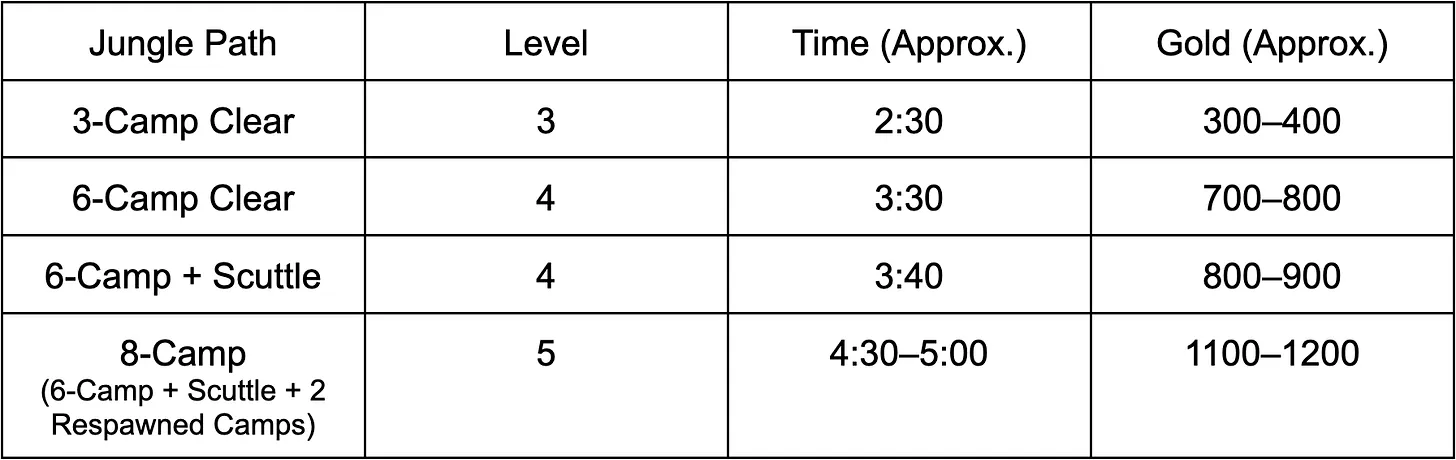
As shown in the table above, junglers generally follow a few core pathing structures, then adjust their decisions in real time based on lane states, gank opportunities, and potential skirmishes.
So what actually differentiates one jungle path from another? And why do junglers sometimes change the order of camps even when following the same overall route?
To answer these questions, we can break early jungle pathing into three major structures. Below, we take a closer look at how each path works and how it can be applied in real games.
A 3-camp path skips one side of the jungle and reaches level 3 using a combination of Gromp or Krugs, a buff camp (usually Red Buff), and one additional camp. After hitting level 3, the jungler immediately transitions into the next action.
Because one camp is skipped, this path prioritizes early pressure over farming efficiency. It is best suited for early ganks or counter-jungling plays.
When choosing a 3-camp path, you should consider the following factors:
Champions that use 3-camp paths effectively tend to have strong single-target clear speed and strong early combat power. For example, a Buff to Raptors to Gromp route allows you to reach level 3 quickly and immediately look for a gank.
Clearing Raptors early also reduces risk. By clearing Raptors early, you remove one of the easiest camps to steal. Even if the enemy invades later, the remaining camp trade usually favors you or limits potential losses.
The 6-camp path is the most stable and consistent farming route. It usually starts on either the top or bottom side of the jungle and clears all six camps, while still allowing flexibility to pivot into a gank if an opportunity appears.
The most important decision in this path is your starting camp. Starting on a 1:30 camp such as Raptors or Wolves sets the timing for your entire respawn cycle, which is why this decision has a major impact on long-term farming efficiency.
With a standard clear on most practiced jungle champions, it is often possible to finish all six camps before the first Scuttle Crab spawns. If you start on Raptors, the respawn timing typically aligns around the four-minute mark, maximizing long-term farming efficiency.
At this point, you can look for an invade on the enemy Raptors or force an early skirmish based on lane priority. If both junglers start on Raptors and one fails an early gank, the other can punish this by counter-jungling, creating a meaningful tempo and experience advantage.
Starting on a buff can help prevent these scenarios. It allows you to plan early lane involvement while deliberately delaying Raptor respawn timing, giving you more control over your early-game tempo and decision-making.
The 8-camp path is a full farming route that follows a Raptors start, clears all six camps, secures the Scuttle Crab, and then clears two respawned camps. This approach is commonly seen in high-elo and professional play.
After taking Scuttle Crab, the second spawn of Raptors and Krugs naturally comes online around the four-minute mark. This often enables a strong first recall, usually around 1100 gold in many games, and sets up a smooth path toward a level 6 power spike.
This path is especially effective for the following types of champions:
However, the 8-camp path is more difficult to execute in lower tiers. Between four minutes and five minutes, lane volatility and frequent gank windows make it easy to miss impactful opportunities while focusing on farming. In these situations, the opposing jungler may seize tempo and gain early control of the map.
That said, when the early game remains relatively stable during the first five minutes, the 8-camp path provides exceptional gold and experience efficiency, setting up a strong mid-game foundation.
So which champions should choose a 3-camp path, and which ones benefit more from a 6-camp clear?
There is no single correct jungle path. Pathing decisions should always be flexible, adapting to champion strengths, team compositions, and overall game plans. Even on the same champion, different situations can call for different paths.
In general, 3-camp paths are better suited for damage-oriented junglers rather than tank-focused ones. Because failed ganks or counter-jungle attempts carry higher risk, strong early skirmishing power and reliable crowd control are key factors.
For example, champions like Elise and Rek'Sai, who have access to crowd control, often look to gank as soon as they reach level 3. On the other hand, champions such as Graves and Kindred lack hard CC but excel in one-on-one combat, making counter-jungling a more common choice.
By contrast, tank junglers with weaker early combat power, like Zac or Amumu, typically avoid direct early confrontations. These champions often start on the opposite side of the enemy jungler and opt for a stable 6-camp path to secure consistent growth.
That said, strong early fighters do not always default to 3-camp paths, and tank champions do not automatically lock themselves into full clears. Sejuani is a tank with strong early skirmishing potential, while champions like Nocturne may choose between 3-camp and 6-camp paths depending on team composition and matchup, especially due to the high value of their level 6 power spike.
In modern jungle play, leashless starts have become increasingly common, with Raptors starts being especially popular. Early-fighting champions can take advantage of this by ganking at level 3 or by setting up fights and counter-jungle plays around the enemy’s four-minute Raptor respawn timing.
Conversely, champions with weaker early games can focus on farming, use vision to track these timings, or adjust their starting position to discourage enemy invades altogether.
Every jungle path exists for a reason.
Gromp and Krugs provide the highest experience and are essential for efficient level 3 paths. The first camp spawn at 1 minute 30 seconds and the Scuttle Crab timing naturally connect with a Raptors start, while the second Raptors spawn around four minutes becomes a critical window for skirmishes and counter-jungling.
When you understand these underlying structures and timings, you can respond flexibly to unexpected situations and irregular game states instead of relying on rigid, scripted paths.
Found this helpful? Try STATUP.GG for completely free real-time voice coaching in-game.
Questions or feedback? Email us anytime at contact@gamerrepublic.gg
STATUP.GG provides real-time AI Voice Coaching for League of Legends. Improve every game by playing smarter, reacting faster, and learning as you play with STATUP.GG.

